
Blog
Recent Posts

What is a Digital Signal Processor?
A sound wave travels approximately 34cm per millisecond. In a home, it really doesn’t matter; however, in a car you’ll find that you are much closer to one door speaker than the other. As a result, your ears will receive the sound from each at slightly different times. This can distort the music, making vocals appear as if they’re coming through the nearest door. This is where a DSP can help.
Why would I need a DSP?
Listening to music in a car isn’t ideal. There’s a lot of glass causing high frequencies to bounce around, seats absorbing some frequencies, and door panels causing rattling. The speakers are also placed wherever there was available space in the car manufacturer’s design. Usually low down in the door, meaning they point towards your knees. This can cause an uneven sound from even a high-end car audio system. Upgrading the speakers will improve the sound; however, the issues caused by the room itself and speaker placement can’t be fixed by upgrading speakers alone.
What is a Digital Signal Processor?
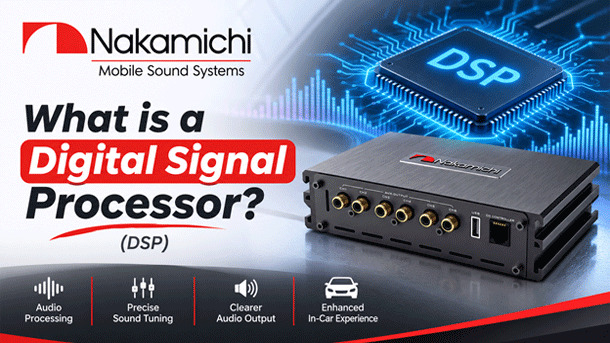
A Digital Signal Processor car audio unit is basically a small computer. It receives the music signal, converts it from an analogue signal to a digital one, allows the software to manipulate the signal, and then converts it back to an analogue signal to go to your amp. Sometimes they’ll be referred to as a Digital Sound Processor car audio unit. The name can change depending on the brand; however, they all do the same thing.
How does a DSP improve sound quality?
The main thing it does is time alignment. By delaying the nearest speakers by a fraction of a millisecond, all sounds arrive at your ears at the same time. This makes the stage appear to move from the doors up onto the dashboard. It also has an equalizer, often with 31 bands, to smooth out any peaks and troughs that are created in your cabin. The crossovers are the unsung hero of a DSP. They stop the small door speaker from trying to produce bass it cannot. This also allows the tweeters to stay out of trouble. Once a DSP car audio system is set up correctly, you’ll often notice subtle details in songs you’ve been listening to for ages.
Difference between a DSP and Amplifier?
An amplifier provides power. The DSP tells the system what to send to each speaker and when. Often people confuse the two, as many amplifiers come with built-in DSP. However, you need both. Without the DSP, the music will just be louder and messy. Without enough power, the DSP will lack power at higher volumes. It’s best to have both.
Do I actually need one?
To be honest, not for everyone. If you’re listening at low volumes through your stock speakers and happy, then don’t bother. However, if you’ve upgraded with an amplifier, better speakers, or a subwoofer, then definitely. People will sometimes ask about a DSP for car audio to increase volume, but it won’t on its own. The volume will come from your amplifier. The clarity will come from the DSP.
Standalone DSP or DSP amplifier?
A standalone DSP will go between your head unit and amplifiers. This increases the number of outputs and allows for greater control. If you have a larger build with separate amps, this is a great option. A DSP amplifier will combine the two into one unit. This reduces the amount of wiring needed and saves space in your boot. If this is your first upgrade, I would recommend a DSP amplifier. It’s much easier to install and is usually cheaper than buying separately.
Nakamichi started in Japan in 1948. They became well known for their Dragon cassette deck in the early eighties. It was renowned for being very careful with the signal. Because of this, customers looking at Nakamichi car audio in India will often ask the right questions.
How important is a professional DSP?
More so than the hardware. A good DSP in untrained hands can actually sound worse than having no DSP. The DSP will begin by using a measurement microphone at the driver's seat. This will show any peaks or troughs in the cabin. The installer will then adjust these. They will also add delays and set crossover points. However, the next step can’t be done by software. Having a tuner who knows the songs well and can adjust by ear usually works better. Don’t skimp on a car audio DSP processor and expect it to take a few hours to set up.
How do I install a car audio DSP processor?
Install the unit somewhere dry and well-ventilated, ed such as under a seat or in the boot. Run a fused power lead from the battery. Ensure there is a good earth to bare metal. Run a remote turn-on wire. Connect the signal. If your stereo has preamp outputs, then use these. If not, run the DSP into the speaker-level inputs. Connect the outputs to your amplifiers. Connect your laptop/phone and start setting up.
I would recommend getting someone to fit it unless you’re confident with car wiring. If there’s a bad earth, you’ll have a hum which can’t be removed by tuning.
Should I add a DSP?
If you care about how your music sounds and have invested in speakers or an amplifier, then yes. It’s often the cheapest large upgrade you can do. Many owners comment on immediately noticing the difference, as the sound doesn’t come from the doors anymore. If you just want the loudest system for the lowest price, then invest elsewhere.
If you want to upgrade your car audio system with a digital signal processor car audio but don’t want to turn it into a project, then look at what Nakamichi car audio India has to offer. Ask for a demo with your own songs. A digital sound processor car audio should be judged by how it sounds.
Leave a Reply
Your email address will not be published. Required fields are marked
Comments